
100% Free Consultation – Limited Availability

PDO Hair Stimulation Threads

Effective and safe modality
for hair restoration

PDO Hair Stimulation Threads

Scalp threading with polydioxanone monofilament threads: a novel, effective and safe modality for hair restoration

The current medical treatment options for androgenetic alopecia
(AGA), although effective, tend to show a plateauing-off of the
response with no further hair growth.1 Hair transplantation is
unacceptable to many patients owing to it being a surgical
modality and/or the cost involved.

Polydioxanone (PDO) threads have emerged popular for
non-surgical face lift. Foreign body reaction-induced neocollagenesis, mechano-transduction (mechanical stimuli-induced
fibroblastic response), regulation of gene expression and
improved microcirculation seem to be the plausible mechanisms.2
Microneedling using a dermaroller is another efficacious facial
rejuvenation procedure that creates cutaneous micropunctures
with release of growth factors such as platelet-derived growth
factor (PDGF) and others.3,4 This effect has been extrapolated to
stimulate hair growth, confirmed by the results of a randomized
double-blind trial.4 Akin to this therapeutic strategy, we assessed
the response of male AGA to the scalp insertion of PDO threads.
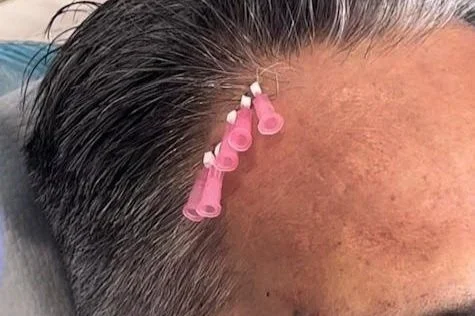
Insertion of the polydioxanone-loaded needles at regu- lar spacing into the intradermal plane of the scalp skin (a), A com- pletely threaded scalp with 35 polydioxanone-loaded needles inserted in a radial distribution (b).

Microneedling using a dermaroller

Microneedling using a dermaroller is another efficacious facial
rejuvenation procedure that creates cutaneous micropunctures
with release of growth factors such as platelet-derived growth
factor (PDGF) and others.3,4 This effect has been extrapolated to
stimulate hair growth, confirmed by the results of a randomized
double-blind trial.4 Akin to this therapeutic strategy, we assessed
the response of male AGA to the scalp insertion of PDO threads.
We evaluated the efficacy and safety of PDO thread insertion
into the scalp in five male patients of AGA with unsatisfactory
response despite 18 months of treatment with 10% minoxidil
and oral finasteride; enrolling them after written consent, ensuring a 3-month wash-off period from previous therapies, and
having ruled out any contraindications.
The primary end-point of efficacy evaluation was the global
photographic improvement (GPI), with secondary end-points
being: (i) comparison of the trichoscopic hair count in the target
area; and (ii) degree of patient satisfaction on visual analogue
scale (VAS) ranging from 1 to 10. The trichoscopic hair count
was done in 1 cm2 targeted fixed area at baseline and at end of
therapy (week 12).

Our Process

Monofilament PDO threads (30 mm long) were inserted into
the scalp (vide infra) under topical anaesthesia and sterile precautions. The threads were inserted in the intradermal plane,
attempting to pass the thread through the maximum possible
length per needle. Multiple needles were inserted at 1 cm spacing (Fig. 1a) in a radial orientation. The total number of needles
inserted ranged from 20 to 40 per scalp (Fig. 1b). During insertion, the scalp skin was stretched by the surgeon’s non-dominant
hand to make it taut, and the needle was inserted through the
desired point by the dominant hand. The needles were withdrawn leaving the PDO threads in situ. Oral antibiotics for
5 days, and a mild shampoo after 48 hours were suggested

Follow-up visits

Follow-up visits were done at 2 weeks, 6 weeks and 12 weeks after the procedure.
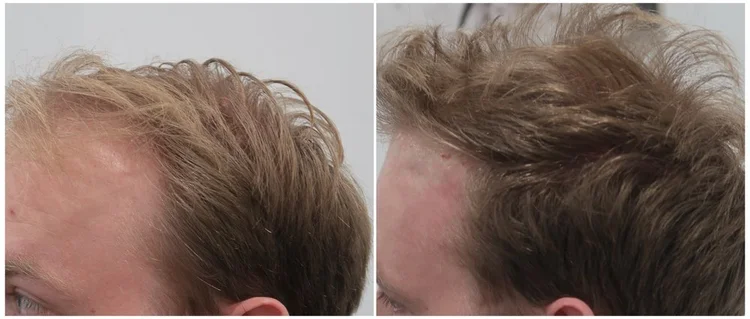
At 12 weeks, all patients (n = 5) had appreciable degree of increase in hair counts, confirmed with investigator-evaluated improvement in GPI (40%–75%; average of 57%) (Fig. 2), trichoscopic hair count increment (48-93 HFU/cm2 ; average of 67 HFU/cm2
) and patient satisfaction evaluated with VAS ranging
from 4 to 8 with a mean of 6 (Table 1).
Except for mild pain experienced during thread insertion (n = 5), and mild transient swelling (n = 2), the procedure was very well tolerated by all. There was no case of significant bleeding, ecchymosis, persistent pain, headache or postprocedure infection.
Polydioxanone (PDO) filament, a synthetic absorbable suture prepared from polyester, poly (p-dioxanone) has high flexibility and high retention strength, is non-allergenic and has a slow absorption rate (6–8 months).

 Pre procedure picture of a 31-year-old male patient with grade III androgenetic alopecia (a), postprocedure picture (at 12 weeks) of the same patient with around 60% global improve-ment (b).

Procedure Risks

The risk of bacterial colonization or infection is minimal. As a non-surgical face lift modality, threads stimulate neocollagenesis within 2–3 weeks with clinical results expected to last for 2–3 years.1 We preferred monofilament threads, instead of barbed/screwed.
Although the exact mechanism of action of hair growth stimulation by PDO threads remains speculative, it is likely to be similar to that of microneedling, involving enhanced expression of hair-related genes, release of growth factors like PDGF and direct activation of stem cells in the hair bulge area.3,5 A randomized trial by Dhurat et al.4
had indeed displayed the superiority of the combination of microneedling with minoxidil over
minoxidil alone in MPHL.
Although this pilot study seems to offer scalp threading as a novel efficacious and safe non-surgical approach to hair regrowth, the limitations of this study including small number of cases, limited follow-up period and lack of scalp histological analysis warrant further research with controlled trials with a larger cohort.
Further, the persistence of the hair growth-stimulating effect of the threads, and theoretical possibility of foreign body granuloma
formation in the long term remain to be explored.

Age (years)Grade of AGA†GPI (%)Increase in Hair Count‡VAS
27II7593 HFU8
31III6064 HFU6
32II5059 HFU5
36IV6071 HFU7
38III4048 HFU4

The results of scalp threading in five male patients with androgenetic alopecia at 12 weeks

  • †As per Hamilton-Norwood scale of male patterned baldness.
  • ‡As per trichoscopic analysis of the premarked targeted area of the scalp.
  • AGA, androgenetic alopecia; GPI, global photographic improvement; HFU,
    hair follicular unit; VAS, visual analogue score

Disclaimer

“We confirm that the manuscript has been read and approved by all the authors, that the requirements for authorship as stated earlier in this document have been met, and that each author believes that the manuscript represents honest work”.
J. Bharti,1 S. Sonthalia,2,* P. Patil,3 R. Dhurat4
1 Department of Dermatology, Paras Hospital, Gurgaon, India,
2 SKINNOCENCE: The Skin Clinic, C-2246, Sushant Lok-1, Gurugram,
India, 3 Skin Radiance Clinic, Civil lines, Gurugram, India, 4
Department of Dermatology, L.T.M. Medical College and General Hospital, Sion,
Mumbai, Maharashtra, India
*Correspondence: S. Sonthalia. E-mail: sidharth.sonthalia@gmail.com
The work was carried out in Paras Hospital, Gurgaon, India.

References

  1. Sonthalia S, Daulatabad D, Tosti A. Hair Restoration in androgenetic alopecia: looking beyond minoxidil, finasteride and hair transplantation. J Cosmo Trichol 2016; 2: 1–13.
  2. Suh DH, Jang HW, Lee SJ et al. Outcomes of polydioxanone knotless thread lifting for facial rejuvenation. Dermatol Surg 2015; 41: 720–725.
  3. Jeong K, Lee YJ, Kim JE et al. Repeated microneedle stimulation induce the enhanced expression of hair-growth-related genes. Int J Trichology 2012; 4: 117.
  4. Dhurat R, Sukesh M, Avhad G et al. A randomized evaluator blinded study of effect of microneedling in androgenetic alopecia: a pilot study. Int J Trichology 2013; 5: 6–11.
  5. Kim BJ, Lim YY, Kim HM et al. Hair follicle regeneration in mice after wounding by microneedle roller. Int J Trichology 2012; 4: 117.